
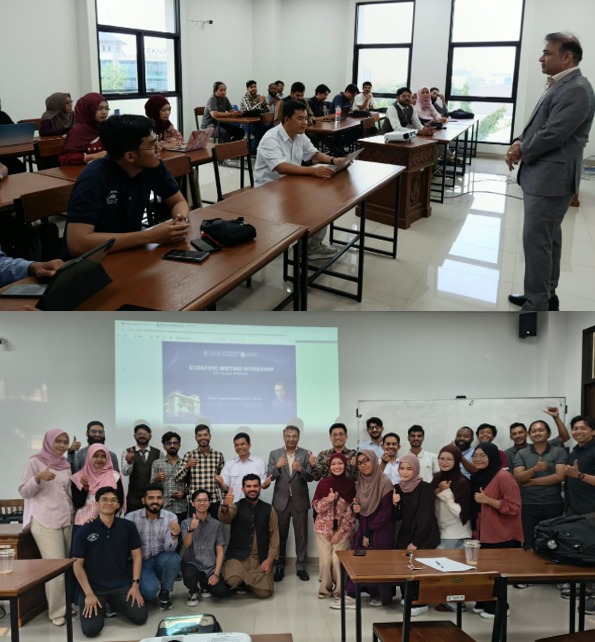
Semarang, October 1, 2026 – The Faculty of Animal Science and Agriculture (FPP UNDIP) at Diponegoro University organized a Scientific Writing Workshop with Prof. Muhammad Asif Raza, Adjunct Professor at FPP UNDIP, held at Room G301, FPP UNDIP. The workshop served as a learning and academic consultation forum for students to strengthen their understanding of scientific research and academic writing.
The workshop was attended by students from various educational levels and academic backgrounds, not only from FPP UNDIP but also from other faculties across Diponegoro University. Participants included master’s and doctoral students, as well as international students from various countries, creating a diverse academic environment and bringing together different research perspectives.
Prof. Muhammad Asif Raza is an Adjunct Professor at FPP UNDIP and Dean of the Faculty of Veterinary and Animal Sciences at Muhammad Nawaz Shareef University of Agriculture, Multan, Pakistan. Through his role as an Adjunct Professor, Prof. Muhammad Asif Raza contributes to strengthening education, research, scientific publication, and international academic networks at FPP UNDIP.
In his presentation, Prof. Muhammad Asif Raza discussed the fundamentals of research in a systematic and comprehensive manner, covering the definition of research and the reasons why research needs to be conducted, as well as preliminary observations, idea development, objective setting, formulation of scientific questions, problem identification, hypothesis development, and the selection of appropriate research approaches. Each stage was explained as an interconnected component that should be organized within a logical research framework. Students were also encouraged to identify knowledge gaps, formulate research problems accurately, and establish objectives that can be addressed through scientific methods.
One of the key points emphasized during the workshop was that research findings do not always have to conform to the initial hypothesis. Research may produce findings that support or reject a hypothesis, or may yield results that are not statistically significant. Non-significant findings still have scientific value when the research is well designed, employs appropriate methods, is conducted consistently, and is analyzed objectively. Therefore, the purpose of research is not simply to obtain statistically significant results, but to discover scientific answers based on data and evidence.
Differences between research findings and initial assumptions should not immediately be regarded as failures. Such findings can provide valuable information for evaluating theories, methods, variables, research conditions, and underlying assumptions. Researchers therefore need to maintain objectivity and avoid attempts to manipulate or direct data to fit a predetermined hypothesis. Findings should be interpreted honestly and critically by considering the research design, data quality, limitations, and broader scientific context.
In addition to the presentation, the workshop provided students with an opportunity to discuss their ongoing research directly with Prof. Muhammad Asif Raza. Participants presented their research topics, objectives, problems, and progress to receive feedback on research focus, the relationship between research problems and objectives, conceptual frameworks, the formulation of research questions, the placement of hypotheses, variable selection, and the interpretation of findings.
The discussion session was highly interactive, with the topics tailored to the characteristics of each participant’s research. Various challenges, ranging from topic selection and research design to data collection, analysis, and scientific writing, were also discussed. The feedback provided was not only theoretical but also practical, enabling students to examine their research problems from different perspectives and consider alternative solutions appropriate to their respective research contexts.
The diversity of participants from different faculties, educational levels, and countries further enriched the dynamics of the workshop. Master’s students had the opportunity to strengthen their understanding of research fundamentals and prepare for thesis writing, while doctoral students were able to discuss more complex issues related to dissertation development and scientific publication. The participation of international students also broadened the exchange of experiences concerning research cultures, educational systems, and scientific approaches across different academic contexts.
Through the Scientific Writing Workshop, FPP UNDIP seeks to strengthen students’ capacity to design, conduct, analyze, and communicate research in a systematic, rigorous, and accountable manner. The activity also contributes to fostering an inclusive, interdisciplinary, and internationally oriented learning environment through the involvement of the Adjunct Professor in education and the development of academic networks.
The workshop is expected to enhance students’ confidence throughout the research process and build a deeper understanding that research quality is determined not only by the significance of the findings, but also by the clarity of scientific questions, the appropriateness of research design and methodology, data quality, objectivity in analysis, and the ability to communicate findings honestly and responsibly. With this understanding, students are expected to produce research that meets academic standards while contributing to the advancement of knowledge and the resolution of various challenges facing society.